The Illusion of the “Dorayaki Maker”: Sourcing the Physics and Tools of Authentic Wagashi
Stop searching for a automatic dorayaki machine. Learn why physical molds ruin the delicate “mimi” edge, why Western steel griddles cause uneven browning, and our risk-free, phase-by-phase equipment roadmap.
Part 1: The Trap of the Mold (Why There Is No Automatic Maker)
In high-end Western pastry, chefs are accustomed to mechanical consistency. We rely on waffle irons, tart shell presses, and tailored molds to secure identical shapes under tight dining room timelines. When introducing dorayaki to a fine dining menu, it is natural to search for a “dorayaki maker”—a clamshell machine or a molded plate designed to standardize the bake.
However, in the world of professional Wagashi, molds are the enemy of authenticity.
If you attempt to bake dorayaki batter inside a physical ring or mold, you will completely ruin its structural beauty. A legendary dorayaki cake is defined by its gently tapered, elegantly closed edge—what Japanese artisans call the Mimi (耳 / the ear). The Mimi must curve gracefully inward, creating a soft, hermetic seal around the red bean heart.
When batter is forced into a physical mold, it behaves like an English muffin or an Imagawa-yaki. It develops vertical, blocky, cliff-like walls. This completely destroys the delicate mouthfeel and ruins the visual refinement required of an elite plate.
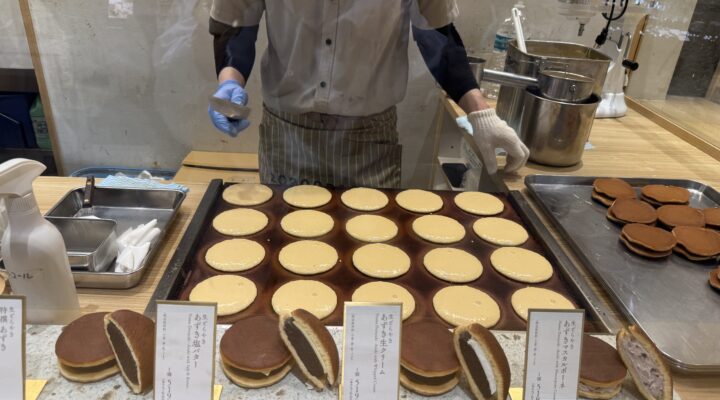
The tapered Mimi cannot be engineered by a machine; it is a fluid dynamics phenomenon. It is created on a completely flat surface where the batter’s surface tension, controlled viscosity, and heat-induced gas release are balanced in perfect, unconstrained harmony. To achieve this, you do not need a specialized automatic maker. You need to master the physics of the hand.
Part 2: Why Western Commercial Steel Griddles Fail
Once chefs accept that dorayaki must be hand-poured onto a flat surface, the next instinct is to use the existing commercial steel flat-top griddle in the restaurant kitchen. This is a severe technical mistake that leads to heavy product waste.
Western kitchens are dominated by steel flat-tops designed for high-heat, fat-rich cooking—such as searing meats, burgers, and bacon. These griddles fail the Wagashi standard for two chemical reasons:
- 1. Thermal Hot Spots & Thin Construction: Steel griddles do not distribute heat with mathematical uniformity. They suffer from localized hot spots directly above the burners or heating elements. If you pour twenty delicate, sugar-dense dorayaki cakes onto a steel plate, they will brown at wildly different rates. Some will burn black while others remain pale and raw.
- 2. Flavor Contamination & Oil Pores: Steel is a porous metal. Over years of service, animal fats, proteins, and savory seasonings seep deep into the microscopic pores of the griddle surface. Even after a deep-clean, these residual oils will transfer unwanted savory odors and cause severe, unmarketable splotches and tears on your delicate, fat-free honey cake.
To bake a flawless, uniform, matte-golden Kitsune-iro (fox-brown) skin, the industry standard demands a thick, dedicated, solid copper griddle known as a Hiranabe (平鍋).
Copper possesses a thermal conductivity rate roughly five times higher than steel. A thick copper plate acts as a thermodynamic flywheel, absorbing heat and redistributing it perfectly across every single square millimeter. Whether you pour six or sixty skins, they will color simultaneously into the exact same rich, velvet-matte finish. Furthermore, the Hiranabe must remain strictly dedicated to your pastry program—shielded forever from savory fats—to preserve the pristine surface tension of the metal.
Part 3: The Risk-Free, Phase-by-Phase Equipment Roadmap
Acquiring professional Japanese copper griddles (Hiranabe) and specialized copper boiling pots from overseas can be a daunting, expensive capital expenditure (CapEx) hurdle. Therefore, we have engineered a systematic, low-risk equipment staircase that eliminates financial risk while maximizing your technical mastery:
Phase 1: The Tactical Test-Bake (Online Master Course / Budget: Under $100)
- Equipment: Your kitchen’s standard gas range + an affordable, thick-bottomed carbon-steel or cast-iron crepe pan (such as de Buyer). No specialized tools are required.
- The Mission: Build your core muscle memory. Using our step-by-step video tutorials, you will practice the exact “sliding pour” from the ladle, calibrate batter aeration, and read the physical bubble patterns on an imperfect domestic heat source.
- Why This Works: Practicing on a smaller, more restrictive crepe pan actually refines your hand control. Once you can consistently pour a perfect, identical 2-centimeter medallion or 8-centimeter disc on a simple pan, graduating to a professional griddle becomes effortless.
Phase 2: The Scaled Signature (Online Advanced Course & 3-Day Tokyo Schooling)
- Equipment: A professional solid-copper Hiranabe (gas or electric) and a specialized copper boiling pot equipped with a fitted wire net-basket (Amikago) to prevent Dainagon Azuki beans from cracking during the boil.
- The Mission: Transition to high-volume commercial consistency. Learn how to manage the intense thermal recovery of copper and master the sugar-honey-dipping method for glossy, whole-kernel fillings.
- Our VIP Procurement Support: Do not waste time trying to translate Japanese kitchen supply websites or risking your capital on unverified importers.
During your 3-Day Intensive Live Schooling in Tokyo, you will work directly with our master artisans in our Shinjuku studio, handling authentic Hiranabe and Amikago pots. Once your signature recipe and volume requirements are locked in, Master Yoko Senoo will personally facilitate your equipment sourcing, connecting you directly with trusted, centuries-old Japanese artisan metalsmiths to hand-craft and ship your dedicated kitchen gear safely to New York, London, or Paris.
Part 4: Witness the Kinetic Science of the Bake
To truly appreciate how the lack of molds allows the batter to breathe and form that iconic, tapered edge, you must see the griddle mechanics in motion.
On our official Instagram page, we showcase real-world kitchen execution from Tokyo’s elite confectioneries. Witness the flawless, oil-free surface glide and the rising air-pocket structures of professional production:
▶ Click Here to Watch the Live Artisan Griddling at Akasaka Ogino Wakan on YouTube
In this showcase, observe how the chef pours the batter with a steady, rhythmic rhythm on a pristine copper surface, allowing the edges to naturally submerge into a perfect, seamless curve without the constraint of a physical mold.
Conclusion: Build the Technique Before the Gear
A brilliant dessert program does not start with a credit card swipe for expensive machinery. It starts with an uncompromised command of physical variables. Master the traditional “San-Do-Wari” chemistry using a simple crepe pan in your own kitchen today, and let us build your professional production line together when you are ready.
The Dorayaki Quality Design Series
Build an uncompromised command of authentic Wagashi engineering. Explore our complete professional knowledge series to master the foundational design laws of Japanese confectionery:
- Pillar Essay: Q. What Defines Dorayaki? The Art of Harmony Between Anko and Cake
- Quality Guide: Q. What Makes Anko Essential to Dorayaki?
- Market Strategy: Q. Could Anko Be the Next Plant-Based Dessert Ingredient?
- Gluten-Free Analysis: Q. Why Don’t Traditional Japanese Wagashi Shops Sell Gluten-Free Dorayaki?
- Texture Design: Q. How Is Dorayaki’s Signature Texture Designed?
- Vegan Strategy: Q. Can Dorayaki Introduce Customers to Vegan Wagashi?
- Pillar Page: Q. Can Sugar Be Replaced in Authentic Dorayaki Recipes?
- Troubleshooting Guide: Q. Why Your Custom Dorayaki Filling Fails (And How to Fix It)
- Compliance Guide: Q. How to Craft Truly Halal-Compliant Dorayaki: The Hidden Alcohol Trap in Traditional Recipes
- Industry Pillar: Q. The Dorayaki Industry Outlook: A Pastry Chef’s Low-Risk Roadmap to Commercial Scaling