Q. Why Your Custom Dorayaki Filling Fails (And How to Fix It)
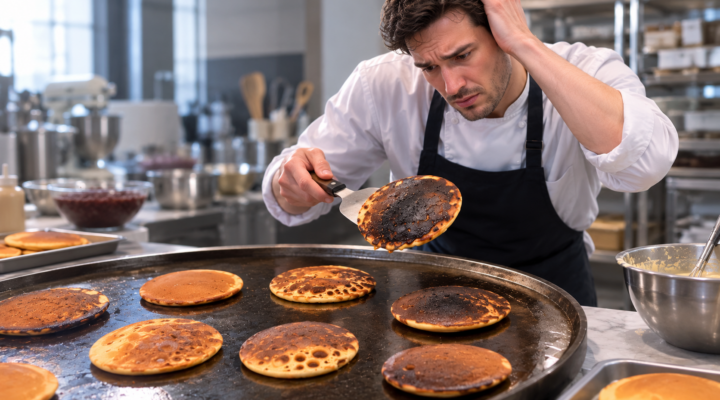
Ambitious pastry chefs searching for a “Dorayaki filling recipe” are usually trying to modernize the format — sandwiching a signature flavor, Matcha ganache, salted caramel buttercream, seasonal fruit confit, between the cakes. And no matter how well the filling itself is executed, the failure shows up within hours: the cake either collapses into a wet, sticky mass, or it separates cleanly from the filling on the bite. That failure has nothing to do with how the filling tastes. It happens because Western fillings carry fat and moisture profiles that violate the osmotic rules the entire format runs on. Therefore the fix isn’t a better filling recipe — it’s establishing a rock-solid cake baseline before you introduce one.
The Trap of Western Fillings
Two failure modes account for nearly every custom filling that doesn’t survive contact with a Dorayaki skin.
Trap 1: The Fat Barrier — Separation.
Buttercream and ganache carry heavy lipid content, and in Western pastry, fat is routinely used to block moisture migration. But as we covered in Q. How Is Dorayaki’s Signature Texture Designed?, the Dorayaki skin is engineered to actively absorb moisture from the filling — that transfer is what produces the integrated melt. A high-fat filling blocks exactly the mechanism the cake depends on, and the result is two isolated textures sitting next to each other rather than one dissolving whole.
Trap 2: The Moisture Tsunami — Sogginess.
Go the other direction — a high-moisture fruit purée or a low-sugar cream — and the Brix differential between filling and cake becomes too steep. Water floods into the sponge faster than its structure can hold, and the delicate cell matrix collapses into a soggy mass that sticks to the fingers instead of melting on the tongue.
The Real “Filling Recipe” Is a Relative Calibration
Traditional wagashi artisans never finalize a filling in isolation. A filling recipe, properly understood, is not a standalone formula — it’s a relationship. Depending on the moisture and fat content of what’s going inside, the artisan recalibrates the cake’s sugar ratio, flour balance, and baking temperature to match it. The “recipe” is the precise relationship between the two components, not either one alone.
For the deeper cultural logic behind why artisans treat that harmony as non-negotiable, see Q. Why Does Texture Matter More Than Filling in Dorayaki?.
Conclusion & Your Next Steps
This is exactly why we don’t teach “filling variations” as a standalone module. Arranging fillings on top of an unstable foundation only produces more of the same failure.
Step 1: Master the Baseline. Establish the absolute benchmark in your own kitchen with The Dorayaki Professional Mastery Path Bundle. You need to understand how the traditional cake and Anko interact before you introduce anything custom.
Step 2: Perfect Your Custom Filling in Tokyo. Once your baseline is locked in, push it yourself first — we recommend 100 trial rounds of the basic recipe and 100 of the advanced recipe, testing where your custom filling destabilizes the texture. Arrive with those hard-won hypotheses. At the 3-Day Intensive Live Schooling in Tokyo, our master chefs will guide you through the exact, gram-level calibration your signature filling needs to reach harmony.
[Explore The Dorayaki Professional Mastery Path Bundle & Secure Your Tokyo Schooling Spot →]