Q. Why Don’t Traditional Japanese Wagashi Shops Sell Gluten-Free Dorayaki?
Part 1: The Molecular Equation Behind San-Do-Wari
When a traditional wagashi house specifies a particular weak wheat flour for its Dorayaki skin, the decision is not custom or habit — it is molecular engineering with a specific, repeatable outcome. The governing formula is San-Do-Wari (“Three Equal Parts”): whole eggs, Johakuto sugar, and weak pastry flour combined in a strict 1:1:1 ratio. By Western baking standards that is an unusually high sugar load, and every gram of it is performing precise chemical work toward a defined sensory target.
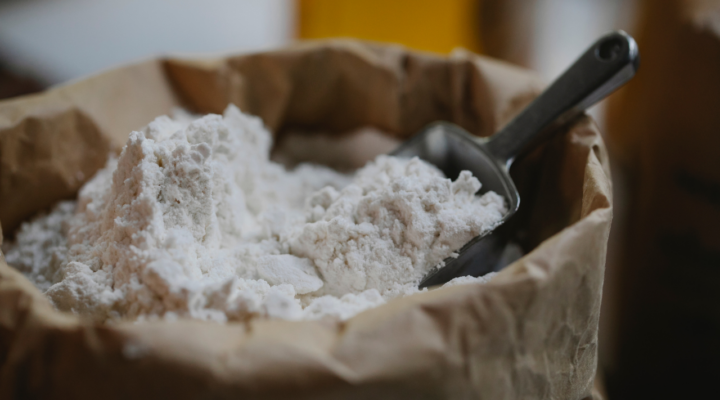
The starting point is gluten. When water meets wheat flour, gliadin and glutenin bond into an elastic network that traps the carbon dioxide released by the leavening agent, holding a fine, uniform cell structure through bake-off. But a Dorayaki skin does not want the strong, chewy elasticity of bread — it wants a scaffold just substantial enough to hold structure and then yield instantly on the bite. Weak pastry flour delivers exactly that minimal network, producing the clean, effortless break — what Japanese confectioners call hagire — that lets the skin sever cleanly rather than stretch or resist.
That high sugar load would destabilize a conventional batter, but within San-Do-Wari it is the mechanism, not the liability. Sucrose is aggressively hydrophilic; it competes with the wheat proteins for free water and wins, deliberately starving the flour of the hydration it needs to over-develop gluten. On paper this reads like a fault — restricted gluten formation — but it is precisely the intent: a controlled, shortening-like interruption of the network that keeps the crumb tender and dense rather than rubbery, generating the soft, fine texture that defines an authentic skin.
And that same sugar load governs what happens after the bake. Wheat starch gelatinizes when heated, absorbing water into a soft, swollen state; as it cools, it retrogrades — expelling water and hardening, the identical staling mechanism that turns cooled rice firm. But the heavy sucrose concentration binds the surrounding water and holds it in place, obstructing the starch’s return to its crystalline, hardened structure. Therefore, the skin retains a velvet, melt-in-the-mouth moisture into the next day and beyond — without dairy fat, without artificial softeners, purely as a function of the ratio. San-Do-Wari is not a recipe. It is a moisture-retention equation calibrated to a specific result.
Part 2: The Rice Flour Question — and a Decision We Made
The modern wellness market has created real commercial pressure to produce a gluten-free Dorayaki, and as an educational program built around menu innovation, we took that pressure seriously enough to test it directly. We commissioned an accomplished Japanese wagashi artisan to develop a commercially viable, 100% gluten-free Dorayaki skin using premium rice flour. The brief was not to produce something “gluten-free-ish” — it was to reach the standard a professional could serve to a paying customer without qualification. The artisan spent months on it, adjusting hydration ratios, resting parameters, griddle temperatures, and rice flour varieties across exhaustive test cycles.
The project failed our quality audit — and the reason is structural, not a matter of effort. Rice flour contains no gluten, so it cannot hold the fine, uniform aeration that gives the skin its delicate crumb; the batter sets dense and tight-grained. More destructively, rice starch is high in amylopectin, which gelatinizes into an aggressive, sticky state — mochi-ka — under heat. Paired with Anko, the rice skin did not break and melt; it clumped into a heavy, doughy mass that sat in the mouth and refused to dissolve alongside the filling. It was, in the most literal sense, executable: we had a formula that produced a gluten-free object shaped like a Dorayaki. But executable and serveable are different standards, and the gap between them is precisely the gap a New York pastry director lives inside during every service. Therefore, rather than lower our standard and teach a compromised “pancake sandwich” that would attach itself to our students’ brands, we made the deliberate decision to abandon the formula and exclude it from the curriculum entirely.
| Wheat (weak flour) skin | Rice flour skin | |
| Structure | Gluten network holds fine, uniform aeration | No gluten — dense, tight grain, poor aeration |
| Behavior under heat | Clean bite, controlled elasticity | Amylopectin drives aggressive sticky gelatinization (mochi-ka) |
| On the palate | Absorbs moisture and collapses with the filling | Clumps into a dumpling-like ball, resists dissolving |
Part 3: Why the Blueprint Dictates Every Substitution
The defining signature of an authentic Dorayaki is a single sensory event: the moment the skin and the filling disappear together on the palate. In a correctly built wheat skin, the gluten scaffold — already weakened by design — collapses the instant it meets the moisture of the Anko and the saliva of the bite, and the boundary between flour skin and bean paste dissolves into a single cream. That simultaneity is the entire reason the format exists.
A gluten-free substitute built without re-engineering the underlying framework cannot reproduce that event. The rice skin clumps into a dense dumpling while the paste washes past it — two textures competing rather than one texture resolving. But the common response to that separation only deepens the problem: chefs reach for more aromatic intensity or chemical stabilizers to mask the structural failure, treating the symptom while the underlying physics remain broken. Therefore, the sequence matters. Before you alter a single gram of a traditional formula to meet a dietary requirement, you must understand what the authentic blueprint is actually doing — which variable carries the moisture, which carries the bite, which carries the harmony — because only then can you substitute without silently destroying the very property that made the original worth serving.
This is the principle the entire Dorayaki Quality Design Series is built on: before changing the recipe, understand what makes authentic Dorayaki successful.
Part 4: The Quality Design Roadmap
We do not teach a gluten-free Dorayaki, because we have not found one that meets our standard. What we do teach is the diagnostic command of the authentic standard itself — the judgment that allows a professional to understand exactly what a substitution would have to replace, and to develop their own variations responsibly rather than blindly.
Step 1: The Dorayaki Professional Mastery Path Bundle
Your training begins in the online curriculum, where your team masters the exact science of San-Do-Wari sugar hydration, oil-free surface grilling, and bean-paste viscosity control — within your own kitchen, using your existing equipment. We expect professional students to complete at least 100 autonomous practice cycles, the repetition volume required to internalize the fluid behavior of the dough and to recognize, by sight and feel, what “customer-serving quality” actually looks like.
Step 2: The 3-Day Intensive Live Schooling in Tokyo
Once your online foundation is locked in, the live residency serves as your final quality audit. Working face-to-face under the direct, sensory supervision of master wagashi chefs, you will refine your hand movements, witness the precise visual cues of fluid consistency, and receive expert verification that your work has reached an uncompromised consumer standard. You will leave understanding not only how to execute the authentic blueprint, but how to read it well enough to engineer your own variations — gluten-free or otherwise — without sacrificing the harmony that defines the craft.
Master the standard. Then innovate from it.
[Explore The Dorayaki Professional Mastery Path Bundle & Secure Your Tokyo Schooling Spot →]
The Dorayaki Quality Design Series
Build an uncompromised command of authentic Wagashi engineering. Explore the complete professional knowledge series:
Pillar Essay: Q. What Defines Dorayaki? The Art of Harmony Between Anko and Cake
Quality Guide: Q. What Makes Anko Essential to Dorayaki?
Market Strategy: Q. Could Anko Be the Next Plant-Based Dessert Ingredient?