Q. How to Test and Scale Dorayaki Production: The Science of Crepe Pans, Steel Griddles, and Copper Hiranabe
Part 1: The CapEx Dilemma in Dessert Innovation
Restaurant owners and executive chefs across New York are constantly hunting for the next breakout menu asset, and an authentic, fat-free, nutrient-dense wagashi item like Dorayaki represents real access to the wellness-dessert segment. But many operators stall at the perceived capital barrier — the fear of dropping thousands on specialized Japanese griddles, or the opposite mistake of grabbing uncalibrated commercial gear and watching the first test batches fail. Therefore neither extreme is necessary. The low-risk path is a two-stage equipment staircase: validate demand first on an affordable crepe pan, then scale to a professional copper griddle once the recipe and the sales volume are both proven.
Part 2: The Crepe Pan Testing Protocol
Before any commercial equipment purchase, a full R&D cycle is achievable for under $100 on a standard domestic crepe pan. Its small surface area makes it, counterintuitively, the ideal entry-level platform for testing temperature limits, oil film thickness, and batter fluid mechanics.
1. Thermal Pre-Heating. Heat the pan fully and evenly over a standard burner. Without a laser thermometer, hold both palms flat, about 50 cm (20 in) above the surface — a steady, radiant heat rising to your hands signals the pan has reached activation temperature.
2. The Micro-Oil Film. Oil is the enemy of a clean, matte kitsune-iro skin. Visible oil droplets cause uneven bubbling and a spotty, marbled surface. Moisten a paper towel with a few drops of neutral oil and wipe the pan until only a microscopic, translucent film remains.
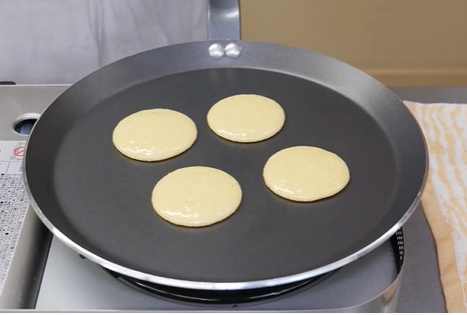
3. Test-Baking and Size Calibration. Run 1–3 trial batches to verify surface heat. For tasting flights and menu testing, start with mini-Dorayaki — roughly 2 cm (1 in) medallions, portioned with a standard tablespoon. Count a steady rhythm (“one, two”) while pouring to keep sizes consistent, laying 5–6 discs in a ring around the pan’s outer edge.
4. Heat Correction. These small cakes cook fast, so watch closely. Pale skin or slow setting means the pan is too cool — wait and reheat before the next pour. Skin that scorches black while the center stays raw means it’s too hot — lower the flame, or on a powerful commercial range, place a wire rack or heat diffuser between the burner and the pan to buffer direct fire.
5. The Actual Goal. This stage isn’t about speed. It’s about learning to cook a proper Anko using tools you already own, and getting real feedback from real diners on mini-Dorayaki before committing further capital.
Part 3: Why Mini-Size on a Crepe Pan — Not Full-Size
At this stage, chefs often ask: if a crepe pan works, why not just bake full-size Dorayaki skins on it? Two structural reasons make mini-size the right call for this testing phase.
Reason 1: Matching pairs need to come from the same batch. A crepe pan cooks one skin at a time. Bake a full-size skin, and by the time the second one finishes, ambient conditions on the pan have shifted — the two skins that need to sandwich the same Anko will not match in color. A Dorayaki is judged as a pair, and a visibly mismatched top and bottom reads as a defect, not a variation. Mini-size solves this by producing 5–6 small discs per pour, all cooked under the same conditions in the same window — giving you enough matched pieces to select genuine same-batch pairs from, rather than forcing together whatever came out of two separate single bakes.
Reason 2: Mini-size avoids the pan’s own hot-spot geometry. A crepe pan’s center and edges do not heat identically — the center typically runs hotter and less stable than the outer ring. A full-size skin has no choice but to straddle both zones, baking unevenly across its own surface. Mini discs, poured in a ring around the outer edge as described in the testing protocol above, stay entirely within the pan’s most thermally consistent zone and avoid the center’s instability altogether.
Together, these two constraints are exactly why the testing protocol calls for mini-Dorayaki rather than a full-size trial run — it isn’t a compromise on ambition, it’s the only way a single crepe pan can produce commercially honest color-matching at this budget tier.
Part 4: Why General-Purpose Steel Griddles Fail
As volume grows, the instinct is to move from individual pans to a wider flat-top. But a standard commercial steel griddle is a trap, not a step up.
Steel flat-tops are built for high-heat, high-fat cooking — burgers, bacon, pancakes — and their heating elements aren’t engineered for mathematically uniform distribution. Drop delicate Dorayaki batter onto one, and discs brown at wildly different rates depending on where they land, making a standardized, premium presentation impossible.
Worse, Dorayaki can never share a griddle with other menu items. The skin depends on a perfectly clean surface holding an even micro-oil film, and cooking meat on the same steel surface drives animal fat and carbonized protein into the metal’s microscopic pores — pores that are practically impossible to deep-clean back to baking purity. Bake on that shared surface and you get splotching, tearing, and savory odor transfer into a product built entirely on delicate sweetness. A dedicated steel flat-top solely for Dorayaki, meanwhile, just wastes valuable kitchen real estate on an uncalibrated piece of equipment.
Part 5: Why Scaling Demands Copper
A professional, scalable Dorayaki program runs on a thick, dedicated copper plate — the Hiranabe.
Copper conducts heat roughly five times faster than steel and carries enough thermal mass to act as a flywheel: the plate absorbs and redistributes heat so thoroughly that every square millimeter sits at the same temperature. That uniformity pays off in three concrete ways. Consistency — whether you’re pouring 6 skins or 60, every one colors to the same matte kitsune-iro, eliminating waste from uneven batches. Lower operating cost — copper’s heat retention means less energy to hold target temperature, which shows up directly in utility bills. Operational simplicity — a predictable surface means staff aren’t burning labor hours constantly adjusting heat or repositioning cakes to dodge hot spots.
Forcing a generic steel flat-top to do a copper griddle’s job is false economy. For long-term volume, the Hiranabe is the structurally sound choice.
Part 6: Your Low-Risk Technical Roadmap
Building a standout dessert program doesn’t require a blind capital gamble. Start small, validate demand, then scale with control.
Step 1: Test & Calibrate (Online Basic Course). The Dorayaki Professional Mastery Path Bundle walks through close-up hand movements and spatula angles so you can master fluid dynamics, batter aeration, and heat control on an affordable crepe pan.
Step 2: Advance Your Chemistry (Online Advanced Course). Once your baseline is consistent, the Advanced Course covers copper griddle thermal mechanics, sugar-water activity (Aw) scaling formulas, and sourcing and cooking premium custom Azuki fillings.
>>>You can larn both basic and advance course in Bundle course.
Step 3: Verify and Launch (3-Day Tokyo Schooling). When your signature menu is ready for commercial launch, our intensive 3-Day Live Schooling in Tokyo puts you face-to-face with master artisans to audit your heat execution and refine your sensory An-bai calibration to a global industry standard.
The Dorayaki Quality Design Series
Build an uncompromised command of authentic Wagashi engineering. Explore the complete professional knowledge series:
- Pillar Essay: Q. What Defines Dorayaki? The Art of Harmony Between Anko and Cake
- Quality Guide: Q. What Makes Anko Essential to Dorayaki?
- Market Strategy: Q. Could Anko Be the Next Plant-Based Dessert Ingredient?
- Gluten-Free Analysis: Q. Why Don’t Traditional Japanese Wagashi Shops Sell Gluten-Free Dorayaki?
- Texture Design: Q. How Is Dorayaki’s Signature Texture Designed?
- Vegan Strategy: Q. Can Dorayaki Introduce Customers to Vegan Wagashi?
- Pillar Page: Q. Can Sugar Be Replaced in Authentic Dorayaki Recipes?
- Troubleshooting Guide: Q. Why Your Custom Dorayaki Filling Fails (And How to Fix It)
- Industry Pillar: Q. The Dorayaki Industry Outlook: A Pastry Chef’s Low-Risk Roadmap to Commercial Scaling