Q. Why Traditional Anko Follows a Different Design Philosophy Than French Pastry Cream?
This article expands on our pillar guide, Q. Why Is Traditional Dorayaki Becoming Relevant to Modern Pastry? — looking specifically at what separates anko from anything in the Western repertoire.
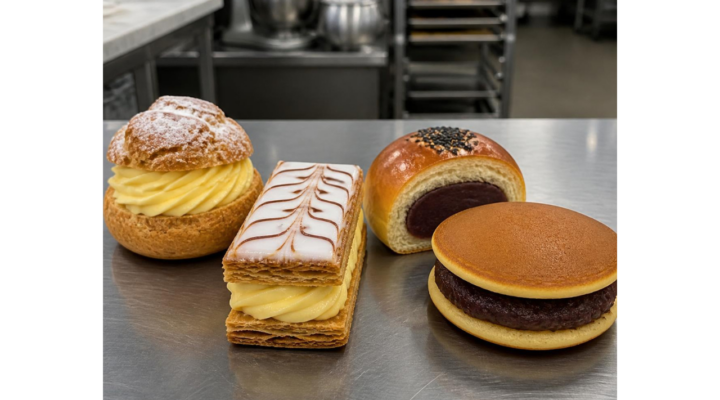
As Dorayaki draws attention from Paris to New York, the instinct among Western-trained chefs is to file anko under something familiar: a Japanese crème pâtissière. A sweet, spreadable paste, sandwiched between two layers of cake — surely mastering it is a matter of finding the right ratio of beans, water, and sugar.
Try it on that logic and you hit a wall. The texture comes out either dense or runny, the flavor reads flat, the bean skins turn papery instead of melting. Which raises the real question: why do master artisans spend decades on something that looks, on paper, like boiled beans and sugar?
Because anko isn’t built on pastry-cream logic at all. Four principles mark where it diverges — and each one reframes something you already know how to do.
1. The Core vs. The Component
In Western pastry, the cream supports the shell — choux, tart, sponge. In Dorayaki, that hierarchy inverts: the honey-cake is the vessel, engineered to vanish on the palate so the anko can hold the center. The design question flips from how do I flavor my filling to how do I build a shell that disappears in service of the ingredient underneath it.
2. Recipe-Driven vs. Ingredient-Driven
Crème pâtissière is food science: hit the temperatures, the starch percentage, the egg yolk weight, and you get the same result every time. Anko runs on the opposite logic — it’s ingredient-driven, because Azuki is a living agricultural product whose moisture shifts with harvest, season, and storage. A master doesn’t boil beans for a fixed time; they read the bean and adjust — soaking duration against the day’s humidity, how many times to change the boiling water (shibukiri) to strip bitterness without losing aroma, when exactly to stage the sugar in so sweetness penetrates the cell structure without toughening it. None of it automates. You learn to read the bean, not the clock.
| French Pastry Cream | Traditional Anko | |
| Driver | Recipe — precise ratios & temperatures | Ingredient — sensorial adjustment to the raw material |
| Raw material | Standardized (milk, butter, starch) | Living, variable (Azuki beans) |
| Execution | Scientific replication | Reading moisture, age, and weather |
The Ingredient Behind the Craft: Anko is deeply ingredient-driven, and it all naturally begins with the raw bean itself. Discover why Azuki is positioned to follow Matcha as the next game-changing Japanese ingredient for modern pastry chefs: After Matcha: Why Azuki Could Become the Next Japanese Ingredient Every Pastry Chef Should Know
3. Sweetness vs. Revelation
In pastry cream, sugar builds indulgence. In anko, sugar has a different job: it doesn’t create sweetness, it reveals the bean — drawing out the nutty, faintly floral aroma while also controlling water activity and shaping final texture. Dump sugar in to make it “sweet” and you drown the ingredient it was supposed to showcase.
4. Uniformity vs. Purposeful Texture
A perfect crème pâtissière is smooth, silky, uniform — any lump is a technical failure. Dorayaki pursues the opposite: Tsubuan’s entire point is calculated irregularity. Bean skins cooked soft enough to melt yet visibly whole. Moisture held at exactly the level that keeps it succulent without whipping air in, which would oxidize the deep purple color. Tender skin, creamy interior, rich syrup — coexisting deliberately, unhomogenized. Where Western training pushes toward absolute smoothness, wagashi is built on a texture that reads as alive precisely because it isn’t uniform.
Moving Beyond the Recipe Card
The distance between Western pastry and wagashi was never a talent gap. It’s a philosophy gap — and it’s exactly why a recipe card alone won’t get you there. Reading a boiling copper pot, feeling the elasticity of a fat-free sponge, trusting a raw material that changes on you: that’s not information you memorize, it’s judgment you build.
Master the philosophy behind anko and you’re not just learning one Japanese classic — you’re picking up a set of tools (moisture control, plant-based texture design, clean-label formulation) that transfers directly back into your Western work.
[Explore our professional curriculum and join the next generation of global pastry innovators →]
These four principles are the philosophy. If you want to go deeper into the mechanics behind them, these three articles from our Quality Design Series break down exactly how that philosophy translates into technique:
Q. What Defines Dorayaki? The Art of Harmony Between Anko and Cake — the pillar essay behind the “core vs. component” hierarchy explored above.
Q. What Makes Anko Essential to Dorayaki? — a closer look at why anko, not the cake, is the protagonist of the format.
Q. Can Sugar Be Replaced in Authentic Dorayaki Recipes? — the pillar guide to sugar’s seven structural roles, including how it “reveals the bean” rather than sweetening it.