Q. Why Is Moisture Control Essential in Authentic Dorayaki?
Part 1: The High-Sugar Paradox — Fat-Free Melt
For a Western pastry chef, moisture usually means fat: a genoise or soft muffin gets its tender crumb from dairy lipids, plant oils, or a post-bake soak (sirop à tremper), and a fat-free sponge that stays hydrated for days sounds chemically impossible. An authentic Dorayaki is exactly that impossibility — completely oil-free, yet delivering a melting mouthfeel that rivals high-fat cakes. And because there is no lipid coating to mask dryness, the entire survival of the crumb rests on the deliberate control of water activity (Aw) and brix concentration.
But this is precisely where health-minded chefs go wrong: the instinct to cut sugar for dietary reasons dismantles the physical network of the dough. Without a high sugar concentration, free water stays loose and unbound, and the sponge sheds moisture to evaporation within hours of the bake.
Therefore, in a Dorayaki, sugar can never be read as a sweetener alone — it is a natural hydrogel, a molecular water-trap that binds free water, lowers Aw, and holds a moist, shelf-stable crumb together without a single drop of butter or oil.
Part 2: Honey & Mirin — Invert-Sugar Synergy
Where Western kitchens reach for industrial additives like trimoline or sorbitol to extend suppleness, traditional Japanese craft achieves the same thermodynamic effect through natural, multi-functional ingredients — specifically premium honey and fermented Mirin. Both are rich in fructose and glucose, monosaccharides with far greater hygroscopic capacity than sucrose; fructose in particular pulls water vapor from the surrounding air, actively defending the crumb even in a dry boutique or retail display. But many menu developers read these liquids as mere flavorings and swap in maple or agave, which disrupts the equilibrium entirely — those syrups carry different molecular densities and lack the precise alcohol-to-sugar balance the structur
e depends on. Therefore the synergy is specific and not substitutable: the trace ethanol in authentic Mirin breaks down tough grain proteins while the fructose locks moisture in place, and together they produce a dense, velvet elasticity that resists staling.
Part 3: Flour & Protein Interlocking
The defining quality of a professional Dorayaki skin is a contradiction: it must be intensely soft and hydrated, yet break with a clean, short bite that never turns gummy or clings to the teeth. Western pancake and waffle batters pursue the opposite — height and spring built on a strong, elastic gluten web driven by chemical leaveners. But in a wagashi skin, a developed gluten network is a defect: it creates a tough, chewy barrier at the cake–filling interface that fatigues the palate and blocks the integration the format exists to achieve. When the flour meets a high-brix sugar solution, osmotic pressure forces the sucrose to pull water away from the grain proteins — and that calculated dehydration is exactly what prevents a rubbery gluten web from forming. Therefore, by restraining gluten while stabilizing the hydrophilic colloids of the Anko alongside it, the sugar interlocks grain starch and legume protein into a single tender system — one that yields cleanly the instant the front teeth enter the pastry.
Part 4: The Thermodynamics of the Copper Plate
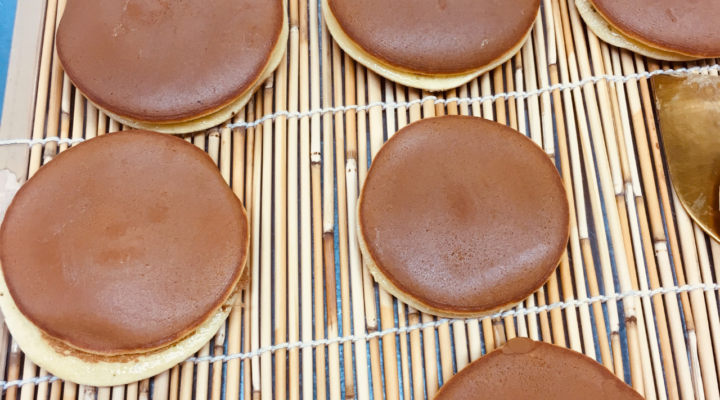
A Western bake relies on an oven’s circulating convection heat to set the air pockets while slowly evaporating interior moisture — ideal for tall, aerated cakes. Dorayaki rejects the oven entirely, using the direct conduction heat of a heavy copper plate to flash-bake one side at a time. The instant the wet batter meets the blazing copper, the concentrated surface sugars trigger an immediate Maillard reaction and caramelization. But attempt the same thing on a thin non-stick pan or in a deck oven, and the heat transfer is too sluggish — the slow thermal rise lets interior steam escape completely, leaving the cake flat, dry, and unmarketable. Therefore the copper plate’s instantaneous high-heat conduction is doing something a gentle heat source cannot: it forms a sealed microscopic crust, a balloon-like outer skin that traps the vital interior steam inside the crumb, delivering a juicy, soft bite within a remarkably thin profile.
Conclusion: Art Over Addition
The moistness of an authentic Dorayaki is never the product of subtraction — it is not a cake left underbaked to hold water. It is a precise addition: sugar chemistry, fructose synergy, protein restriction, and copper-plate thermodynamics working as one system. Borrow the Western shortcuts — brush the skins with syrup, pump the batter with pastry oil — and you are no longer serving a Dorayaki. You are serving a pancake-and-bean sandwich. Achieving world-class mouthfeel from the natural water-binding capacity of sugar alone is the core of the craft.
And that craft is conditional: moving from a working recipe to high-volume production means tuning these moisture-to-sugar ratios against daily humidity and shifting flour lots — the invisible science that separates a consistent product from a variable one.
Step 1: The Dorayaki Professional Mastery Path Bundle. The online curriculum where your team masters San-Do-Wari sugar hydration, oil-free surface grilling, and bean-paste viscosity control — on your own equipment, at your own pace. We expect professional students to complete at least 100 autonomous practice cycles to build a reliable base and understand the fluid behavior of the dough before attempting custom substitutions.
Step 2: The 3-Day Intensive Live Schooling in Tokyo. Your final quality audit. Working face-to-face under the direct, sensory supervision of master wagashi chefs, you will refine your hand movements, see the precise visual cues of correct consistency, and receive expert verification that your work has reached an uncompromised consumer standard — including the copper-plate thermal technique that no home setup can replicate.
Master the invisible science. Then build on it.
[Explore The Dorayaki Professional Mastery Path Bundle & Secure Your Tokyo Schooling Spot →]
The Dorayaki Quality Design Series
Build an uncompromised command of authentic Wagashi engineering. Explore our complete professional knowledge series to master the foundational design laws of Japanese confectionery:
- Pillar Essay: Q. What Defines Dorayaki? The Art of Harmony Between Anko and Cake
- Quality Guide: Q. What Makes Anko Essential to Dorayaki?
- Market Strategy: Q. Could Anko Be the Next Plant-Based Dessert Ingredient?
- Gluten-Free Analysis: Q. Why Don’t Traditional Japanese Wagashi Shops Sell Gluten-Free Dorayaki?
- Texture Design: Q. How Is Dorayaki’s Signature Texture Designed?
- Vegan Strategy: Q. Can Dorayaki Introduce Customers to Vegan Wagashi?
- Pillar Page: Q. Can Sugar Be Replaced in Authentic Dorayaki Recipes?
- Wagashi Taxonomy 101: Japanese Confectionery 101 for Pastry Chefs: Structurally Classifying Dorayaki in the Sweets Universe