
The Leverage of Delegation: How to Standardize Elite Wagashi Training Inside a Western Kitchen
For an executive chef, restaurant owner, or multi-unit operator, introducing a high-margin Japanese wagashi program is not just a culinary decision—it is an operational design challenge. While a plated, chef-designed dorayaki delivers a flawless 10% to 16% raw food cost (COGS), the ultimate success of the program depends entirely on how efficiently you can delegate the technology transfer to your kitchen staff.
In a high-pressure Western commercial kitchen, you cannot afford to have your senior culinary leadership tied to the griddle every night. To scale this program successfully, you must establish an automated, highly repeatable training system that turns your kitchen into a self-sustaining technical engine.
Part 1: The Trainer-Hub Model (Maximizing Your Educational ROI)
The most common mistake made by multi-unit restaurant owners is attempting to send their entire kitchen staff to off-site training. Sending line cooks and prep staff sequentially to an elite hands-on program in Japan is a structural drain on both capital and operational scheduling.
Instead, professional B2B kitchen scaling relies on the Trainer-Hub Model:
- Select Your Hub: Choose a single, high-performing lead—such as your Head Pastry Chef, Sous Chef, or Kitchen Lead—to act as your technical representative.
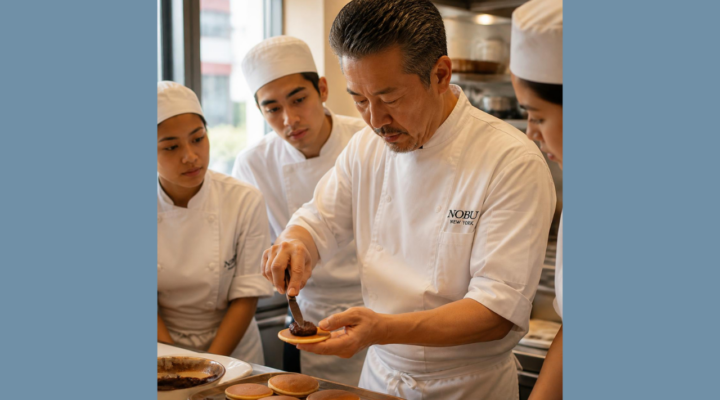
- The Tokyo Calibration: Send this single lead to the high-density 3-Day Tokyo Immersion. Here, they will work face-to-face with Master Yoko Senoo to scientifically calibrate their physical sensory parameters, correct their wrist deceleration, and obtain their official master-certified credentials.
- Internal Technical Transmission: Upon returning, this certified lead becomes your kitchen’s internal trainer and technical hub. Armed with the absolute standard of physical execution, they are equipped to run internal workshops, establish the service-line setup, and audit every plate before it leaves the pass.
By concentrating your offline training investment in a single, dedicated leader, you eliminate massive travel expenses and kitchen station vacancy loss, while establishing a permanent, in-house technical authority.
Part 2: Video as Your Kitchen’s Silent Educator
To support your Internal Trainer and prevent the degradation of technical standards over time, you must integrate digital SOPs (Standard Operating Procedures) directly into your daily kitchen operations.
The Dorayaki Professional Mastery Path Bundle is designed to serve as your kitchen’s silent, automated educator. Because the curriculum is entirely video-based, you can share the system with your staff to automate their theoretical and physical preparation.
- Standardized Visual Cues: Instead of trying to describe the precise batter viscosity or color transformation, cooks can repeatedly watch high-definition, macro-angle demonstrations of starch gelatinization and bubble formation.
- Decentralized Access: By sharing the training credentials within your team, any line cook can review the visual steps on a tablet directly at their prep station before a shift.
- Simultaneous Access and Enterprise Licensing: To maintain strict security and platform integrity, our standard online training portal restricts simultaneous logins from a single account. However, we recognize the multi-terminal needs of commercial kitchens. For operators managing multiple shifts or locations, we offer custom Enterprise Workspace IDs that allow concurrent access for your entire staff. Simply contact our support team to customize a multi-user corporate license tailored to your brigade’s size.
Part 3: The Philosophy of Training Hours (Paid vs. Self-Investment)
When delegating digital training to hourly kitchen staff, operators must make a strategic decision regarding their kitchen’s internal training culture. How you position video training hours shapes your brand’s operational excellence and employee retention.
Route A: The Paid Training SOP (Maximum Quality & Consistency)
Under this model, you treat video learning and internal workshops as structured, mandatory work. You pay your hourly cooks for the time they spend watching the online modules, and you budget paid training hours for the hands-on workshops led by your Tokyo-certified lead.
- The Benefit: This approach establishes a highly disciplined, standard-driven kitchen culture. Because the cooks are paid for their training, you hold them to uncompromising compliance. Every check-gate on the QC sheet must be met flawlessly, resulting in absolute consistency across all shifts.
- The Vibe: Highly structured, professional, and zero-compromise quality assurance.
Route B: The Career Acceleration Badge (Self-Investment & Status)
Under this model, you position access to the elite wagashi curriculum as a premium benefit and a tool for career advancement. The online learning is self-paced and voluntary.
- The Benefit: You attract highly motivated culinary talents who view the mastery of rare, authentic Japanese pastry as a powerful credential for their resumes. Learning this craft becomes a “badge of honor.” Staff invest their own time to master the theory because they know that being selected to run the high-margin dorayaki station elevates their status in the kitchen and accelerates their career path.
- The Vibe: Entrepreneurial, growth-oriented, and highly aspirational.
Whichever route fits your brand identity, using the digital bundle as your core curriculum ensures that the educational baseline is standardized before a single egg is cracked.
Part 4: Replicating the “Tokyo Standard” with Binary Checkpoints
The biggest flaw of standard cookbooks and free video tutorials is that they only provide subjective steps. They fail to establish clear boundaries for quality control, leaving line cooks to guess when to proceed.
To run a zero-waste, high-margin program, your certified trainer utilizes the binary, physical check-gates built into our curriculum. These are compiled on the wall of your prep kitchen as a hard-copy Quality Control sheet:
| Step | Subjective Recipe Standard | B2B Binary Check-Gate (Yes/No SOP) | Recovery Protocol (Troubleshooting) |
|---|---|---|---|
| 1. Adzuki Boiling | “Simmer until soft.” | Have the wrinkles on the adzuki skins fully stretched? | If No: Continue simmering with incremental hot water additions. Do not apply sugar. |
| 2. Batter Aeration | “Whip until light and pale.” | Has the egg-sugar ribbon reached a 3-second trail stability? | If No: Whip for an additional 45 seconds on speed 3. Check batter temperature. |
| 3. Pan Preparation | “Grease the pan lightly.” | Is the oil layer wiped down to a paper-thin, non-beading film? | If No: Wipe surface firmly with a dry huck towel until no grease beads are visible. |
| 4. Griddle Heat | “Heat griddle to medium.” | Is the surface thermometer registering exactly 170°C (338°F)? | If No: Adjust heat source and wait 90 seconds for thermal equilibrium before pouring. |
Using this strict, visual checklist, your Internal Trainer can audit a cook’s performance in 10 seconds. It removes the need for “chef’s intuition,” turning a complex, artisan craft into a precise, bulletproof assembly line that runs flawlessly even when you are not in the building.
Conclusion: Build a Training Engine, Not Just a Kitchen
In an era of high labor turnover and rising operating costs, your kitchen must operate as an efficient training engine. Investing in a structured training pipeline is the only way to protect your brand’s quality standards while maintaining a high-margin dessert program.
By pairing the convenience of digital training with the absolute validation of a 3-Day Tokyo audit, you build an ironclad operational loop:
- The Digital Base: Standardize your kitchen’s theoretical baseline, SOPs, and troubleshooting guides with The Dorayaki Professional Mastery Path Bundle. Secure your team’s access immediately via our Teachable Secure Checkout.
- The Human Edge: Send your designated Internal Trainer to the 3-Day Tokyo Immersion to obtain physical calibration, final recipe validation, and official technical credentials.
Equip your team with the systems to execute, and let your high-margin wagashi program run on autopilot.
Read More
Q. Why Is Traditional Dorayaki Becoming Relevant to Modern Pastry?
Q. What Defines Dorayaki? The Art of Harmony Between Anko and Cake
Q. What Makes Anko Essential to Dorayaki?
Q. How Do Japanese Confectioners Design Sweetness in Dorayaki?
Online Convenience vs. Tokyo Validation: Why a Hybrid Pathway Is the Only Rational Investment for Pastry Chefs
What Is the Real Cost of Wagashi Mastery? A Cold ROI Analysis for Western Pastry Chefs
Official Wagashi Credential : The Authority of Authenticity: How a Wagashi Credential Validates Your $12+ Dessert Price