What Can Pastry Chefs Learn From Japan’s Dorayaki Brands? Designing Your Restaurant’s Positioning Grid
Introduction: The Search for a Restaurant-Specific Edge
As a high-end restaurant pastry chef, introducing dorayaki to your menu requires a clear brand strategy. While retail consumers view dorayaki as a single, uniform sweet, Japan’s confectionery landscape actually features a sophisticated positioning grid.
If your goal is to command a premium plated price point ($12–$18) in a fine dining environment, you cannot simply replicate retail import packaging or casual grab-and-go styles. Instead, you must design a unique culinary space. By analyzing traditional and modern brands across three new, restaurant-specific axes, you can identify the open metropolitan whitespace for your dessert program.
The 3-Axis Restaurant Positioning Grid
To help you design your signature dessert, we have structured the comparative landscape of Japanese confectionery brands into a dedicated, professional-grade strategic table. This comparison highlights the gap between traditional retail standards and the unique, high-margin opportunities available exclusively to fine dining restaurants:
| Strategic Axis | Retail / Classical Standard | Fine Dining / Gastronomy Opportunity | The Restaurant Positioning Edge |
|---|---|---|---|
| 1. Timeline & Thermal Dynamics | 48-Hour Aged Peak • Achieving moisture equilibrium 24–48 hours post-packaging. • Stable, uniform, room-temperature sweet (e.g., K. Minamoto). | Zero-Minute Chaud-Froid • High-hydration shells baked à la minute. • Paired instantly with house-made frozen sorbets or cold crèmes. | Immediate Sensory Contrast • Cannot survive inside plastic packaging. • Captures fleeting steam and dramatic thermal contrast. |
| 2. Lipid & Moisture Engineering | Pure Fat-Free Hydration • Soft, springy texture driven strictly by egg/sugar hydrogen bonding. • Zero fats or oils in the classic bake (e.g., Usagiya, Kameju). | Precision Hybrid Emulsification • Maintaining a traditional fat-free cake to preserve its clean melt. • Introducing premium lipids (mascarpone, salt butter) directly into the filling (e.g., Wakan). | Micro-Lipid Bridge • Carries deep flavor and velvety mouthfeel. • Adds luxury without compromising the airy crumb structure. |
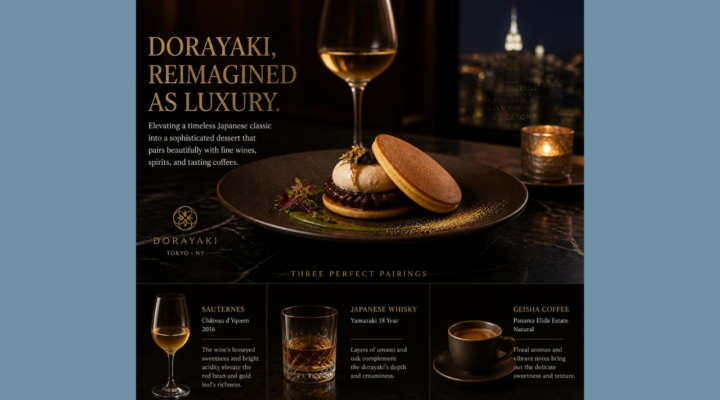
| 3. Brix Balance & Aromatic Complexity | High-Brix Preservation • High sweetness (Brix 55%–65%) using pure Shirozarato sugar. • Acts as a natural preservative; paired with hot green tea. | Low-Brix Aromatic Layers • Sugar reduced to highlight natural bean flavor (short-term consumption). • Infused with single-malt whisky, wood smoke, or citrus acids (yuzu). | Dinnertime Pairing Length • Shifts dorayaki from an afternoon snack to a luxury dessert. • Pairs beautifully with fine wines, spirits, and tasting coffees. |
To see how these concepts translate into actual guest experiences, you can [Master Seasonal Storytelling] to redefine your menu’s structural flow.
While traditional anko remains fat-free, you can [Explore Cream Evolution] to understand how modern creators are carefully introducing dairy without collapsing the cake’s structure.
The Gluten-Free Frontier: Why We Do Not Teach It (Yet)
As you research Japanese brands, you will notice modern players experimenting with alternative starches. For example, legacy brand Suzu-kake incorporates glutinous rice flour (mochiko) to create its signature elastic, chewy texture in the “Sogetsu” shell. Newer wellness-focused brands like SISIRI have even attempted entirely gluten-free recipes using 100% rice flour.
It is tempting to try to replace wheat flour with rice flour to capture New York’s large wellness and allergen-free demographic. However, this is a dangerous path for a professional. Replacing wheat with rice flour triggers heavy starch gelatinization (mochi-ka). This causes the cake to become dense and gummy, clumping in the mouth and separating from the filling rather than melting smoothly.
At the Dorayaki Online School (DOS), we maintain a strict focus on traditional, wheat-based formulation. In fact, our Master Yoko Senoo spent months testing and refining gluten-free recipes in her Tokyo development kitchen. Her conclusion was clear: no gluten-free formulation could meet the uncompromising, melt-in-your-mouth standards of the classical baseline. It did not meet the professional level required for our curriculum.
While we do not teach gluten-free or flour-replacement recipes, we encourage you to first master the classic physics. Once your hands understand how wheat proteins and sugar interact to create the perfect traditional crumb, you will have the scientific foundation needed to explore alternative starches on your own.
Conclusion & CTA: Establish the Baseline First
The axes and ideas proposed here are designed as strategic inspirations, not rigid templates. To build a successful signature dessert, you must first master the rules before you attempt to bend them.
Your first step is to establish a consistent, predictable baseline. By learning the classic San-Do-Wari (1:1:1 egg, sugar, and flour ratio) and mastering the physics of batter viscosity, you build a foundation that ensures your creative variations will succeed.
- Step 1: Build the Foundation Online: Learn the fundamental fluid mechanics, heat management, and water calibration using your existing kitchen equipment with The Dorayaki Professional Mastery Path Bundle (online.dorayakis.com).
- Step 2: Customize Your Menu in Tokyo: Once you have mastered the baseline, bring your unique restaurant concepts, custom fillings, and packaging designs to our private 3-Day Tokyo Schooling (dorayakis.com). There, you will work one-on-one with Master Yoko Senoo to refine your signature program.
Deepen Your Technical R&D (Related Articles)
- Wagashi Taxonomy 101: Wagashi Taxonomy 101: Structurally Classifying Dorayaki in the Sweets Universe
- San-Do-Wari Baseline: Q. How Does Sugar Shape the Color and Aroma of Authentic Dorayaki?
- Takeout Freshness Science: Q. Dorayaki Packet: Why Freshness is the Ultimate Luxury for Your Grab-and-Go Dessert
- Master Seasonal Storytelling : Beyond “Japanese Pancake”: Anchoring Dorayaki on Your Menu Without Losing Your Poetic Voice