Q. Why Does Butter Work So Well with Traditional Anko in Dorayaki?
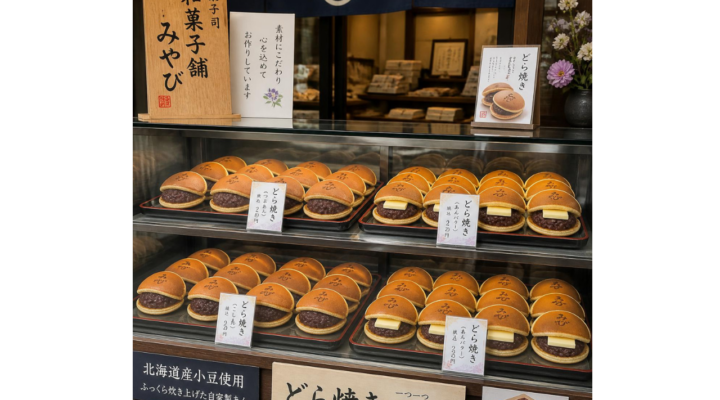
An-butter — sweet red bean paste combined with butter — has become one of the most talked-about modern Dorayaki variations, and Western chefs are increasingly curious about a pairing that looks, on paper, counterintuitive: rich dairy fat meeting a traditional wagashi filling. But the combination isn’t a passing fusion trend. It follows the same design logic that governs every other element of an authentic Dorayaki — and answering why butter works means asking what job it’s actually doing.
1. Butter Is Not the Star — It’s a Balancing Agent
In classical Western pastry — croissant, brioche, puff pastry — butter is often the headline ingredient, its aroma and fat content built to be showcased front and center. Apply that logic to an-butter and it fails immediately, because the dairy was never meant to dominate here. In Wagashi design, butter functions strictly as a harmonizer: not added to compete with the anko, but to draw out its best qualities.
2. Butter Changes the Perception of Sweetness — Not the Sweetness Itself
It’s tempting to assume a block of butter physically dilutes the filling’s sugar content. It doesn’t — the Anko’s Brix level stays exactly where it was. What changes is sensory, not chemical: the fat coats the palate, rounds off sugar’s sharp edges, and shifts how sweetness registers, producing a rounder, more unified flavor without touching the actual sugar math.
3. Butter Adds Textural Contrast
A standard Dorayaki already achieves a delicate melt between soft skin and moist Anko — a small feat of engineering on its own. An-butter deliberately breaks that uniformity by introducing a cold, solid slab into the mix. The disruption is intentional: it builds a sequential experience in the mouth — fluffy cake, then the grain of the bean paste, then the cold, dense melt of butter — rather than one continuous texture.
4. Butter Extends the Finish
Traditional wagashi runs on a culture of subtraction — matcha, sea salt, Yuzu, Kinako — where ingredients ground and frame flavor rather than sweeten it further, and butter follows the same principle. What it adds specifically is duration: without dairy fat, Anko’s aroma compounds dissipate quickly, leaving a short finish. Butter’s milk fat traps those volatile compounds, extending the flavor’s presence on the palate — which is exactly why an-butter pairs so cleanly with specialty coffee or tea.
Another Calculated Tool, Not a Trend
We’ve already established that anko isn’t Japanese pastry cream and that sugar governs water migration rather than simple sweetness. Butter belongs to the same family of decisions: a calculated tool for flavor and texture, not a Western import bolted onto a Japanese classic.
Techniques like this can differentiate a menu instantly — but genuine Wagashi texture design, where every element is this deliberately calculated, is rarely taught outside Japan’s top kitchens.
Step 1: The Dorayaki Professional Mastery Path Bundle. Master these exact benchmarks online, on your own equipment, at your own pace.
Step 2: The 3-Day Intensive Live Schooling in Tokyo. Perfect your signature creation face-to-face under master guidance.
[Explore the Online Bundle and secure your Tokyo Schooling spot today →]