
Q. Dorayaki Batter: How to Maintain Predictable Viscosity Throughout a Busy Dinner Service
This article is a specialized operational guide supporting our foundational pillar: Q. What Defines Dorayaki? The Art of Harmony Between Anko and Cake.
Introduction: The Service Line Challenge
“How do I get consistent dorayaki every time?”
This is the central question for any pastry chef trying to establish dorayaki on a professional restaurant menu. A batter that performs beautifully at the beginning of prep can behave completely differently three hours later during a chaotic dinner service, leading to flat, rubbery, or unevenly sized shells. To serve dorayaki as a premium, high-margin plated dessert, your batter must behave predictably throughout your entire service window.
Why Static Batter Changes Over Time
Once mixed, starch molecules continue to hydrate and gluten structures gradually tighten, causing the batter’s viscosity to increase. Simultaneously, chemical leavening agents lose their gas-releasing power over time. Leaving your batter unadjusted during service guarantees inconsistent results on the griddle.
The Professional 4-Step Protocol for Service Predictability
To achieve identical, micro-foamed shells from the first ticket to the last, you must move from a static recipe to a dynamic adjustment protocol.
Step 1: Resting
Prepare your base batter (eggs, sugar, honey, mirin, and flour) hours before service or even overnight. This resting period allows flour particles to fully hydrate and relaxes gluten tension, ensuring a tender, moist crumb that remains soft even after cooling.
Step 2: Activating
Keep your rested base batter in the refrigerator. Just before dinner service begins, activate the mixture by gently incorporating your leavening agent dissolved in a tiny amount of water. This preserves the maximum gas-releasing potential for when service starts.
The Continuous Loop of “Anbai-tori” (Steps 3 & 4)
Because ambient temperature, kitchen humidity, and hydration levels change constantly, you must repeat the following two steps as a continuous alignment loop every single time you bake a new order.
Step 3: Viscosity Assessment (The Ribbon Rule)
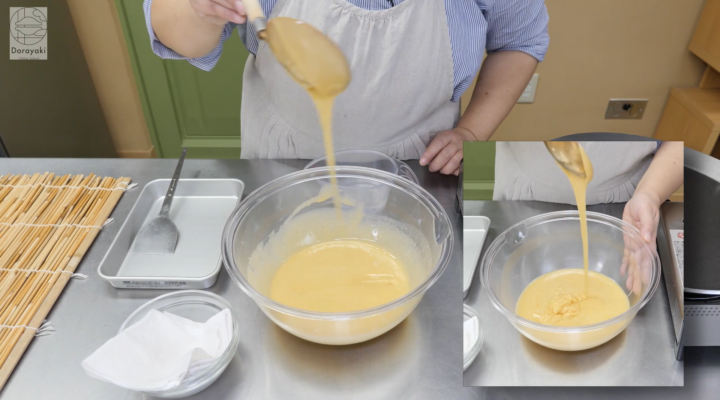
Scoop a generous amount of batter with your ladle and let it stream back into the bowl. Observe how the falling batter behaves on the surface:
- The Adjustment Signal: If the streaming batter folds onto itself and leaves a visible, ribbon-like trail on the surface, the batter is too thick and dehydrated.
- The Target Standard: The batter should flow smoothly from the ladle and immediately dissolve back into the surface without leaving any raised ribbon trail. This indicates the perfect fluid viscosity required to expand into a flawless circle using only gravity and surface tension.
Step 4: Sensory Water Calibration (“Anbai-tori”)
If your batter leaves a ribbon trail, perform the traditional calibration known as Anbai-tori (sensory water adjustment):
- Add a tiny amount of water (adjusting water) directly to the ladle, then gently work it into the batter.
- The Golden Rule: Never stir the batter in a rapid, circular motion. Over-mixing activates gluten, turning your delicate shells tough and rubbery. Instead, use the back of your ladle to cut and fold the water in gently but thoroughly.
- Check the stream again. Repeat this micro-calibration until the falling ribbon immediately disappears into the batter. Because flour behavior depends entirely on daily humidity and ambient temperature, there is no fixed gram weight for this water—it must be adjusted iteratively by sight and feel before every bake.
Master the Fluid Dynamics of Wagashi
Do not let dynamic kitchen environments compromise your pastry standards. Transition your culinary skills into predictable confectionery physics:
- Step 1: Online Practice and Sensory Mastery (The Online Bundle): Master the exact hand postures, ladle strokes, and viscosity checks with The Dorayaki Professional Mastery Path Bundle. You do not need a commercial copper plate to start. Our basic course guides you to use a standard crepe pan to practice the “Anbai-tori” calibration. This allows you to perfect your form and produce mini-dorayaki shells of exceptional takeout quality right in your current kitchen.
- Step 2: Form Verification Live (3-Day Tokyo Schooling): Once you have practiced your ladle control and sensory water adjustments online, join us live for our elite, private 3-Day Live Schooling in Tokyo at Wagashi Labo Ichiyo. Demonstrate your mixing, tempering, and “Anbai-tori” steps in front of Master Yoko Senoo. The master will audit your posture, correct any self-taught bad habits, and ensure your technique runs flawlessly under the pressure of a real service line.
More Read
Takeout Freshness Science : Q. Dorayaki Packet: Why Freshness is the Ultimate Luxury for Your Grab-and-Go Dessert