Is Dorayaki a Japanese Festival Food? What New York Pastry Chefs Can Do With It
If dorayaki is one of Japan’s most recognizable traditional sweets, why don’t you see it everywhere at Japanese festivals?
Dorayaki is unmistakably Japanese. It is small, portable, and easy to eat by hand. Its soft pancake-like shells can also hold many different fillings.
Yet when you picture a Japanese summer festival, dorayaki is rarely the first food that comes to mind.
Instead, you are more likely to see takoyaki, yakisoba, yakitori, kakigori, and other foods designed for eating while walking around a busy festival.
So, is dorayaki really a Japanese festival food?
The answer is more interesting than a simple yes or no.
Part I —Is Dorayaki Actually a Japanese Festival Food?
2. What Do We Usually See at a Japanese Summer Festival?
Japanese summer festivals have their own recognizable food culture.
Takoyaki, yakisoba, yakitori, grilled corn, kakigori, and other stall foods are closely associated with the festival experience. They are prepared or served in a way that suits an outdoor, walk-around environment.
Dorayaki belongs to a different part of Japanese food culture.
It is a wagashi, or Japanese confectionery, and is widely enjoyed as an everyday sweet. Tokyo’s official tourism guide describes dorayaki as one of the approachable Tokyo wagashi that can be casually eaten by hand.
That distinction matters.
Dorayaki is certainly Japanese.
But being Japanese does not automatically make something a traditional festival-stall food.
3. Why Isn’t Dorayaki a Typical Festival-Stall Sweet?
One reason is its cultural context.
Dorayaki has traditionally been associated more with confectionery shops, everyday snacks, gifts, and wagashi culture than with the temporary food stalls of a summer matsuri.
Taiyaki has a much stronger visual and operational connection to street food. It is baked in a dedicated mold, often in front of the customer, and served hot.
Dorayaki does not have such a fixed festival identity.
This does not mean that dorayaki cannot work at a festival.
It means that there is no single traditional festival format that defines it.
And that distinction opens an interesting possibility.
Part II — What Happens When Dorayaki Enters a Japanese Food Festival?
4. New York: Dorayaki Has Already Appeared at JAPAN Fes
Dorayaki is not entirely new to the New York festival scene.
In 2019, JAPAN Fes listed dorayaki from Izakaya Juraku.
But this was not simply a traditional dorayaki served with anko.
The official JAPAN Fes archive describes it as:
Dorayaki with green tea ice cream and red bean paste.
JAPAN Fes: 2019 — Dorayaki with green tea ice cream and red bean paste
This is already a reinterpretation.
The dorayaki becomes the base for a cold dessert experience, combining the traditional red bean filling with green tea ice cream.
In other words, dorayaki was adapted to the environment rather than simply copied from a Japanese confectionery shop.
5. New York Again: A 2023 Example
The experiment did not happen only once.
The JAPAN Fes vendor archive records AM Handmade at events in 2023, with dorayaki listed alongside karaage, pan-fried dumplings, noodles, cold noodles, and matcha snow cookies.
JAPAN Fes New York: Vendor Archive
These examples show that dorayaki can enter a Japanese food festival in New York.
But they also reveal something else.
Dorayaki has not become a fixed category of New York festival food in the way that ramen, takoyaki, karaage, or other Japanese street foods have.
There is no established formula saying:
“This is what festival dorayaki in New York should be.”
That may be an opportunity rather than a weakness.
Part III — Paris Shows Another Possibility
6. Paris Shows Another Possibility
The situation becomes even more interesting when we look at Paris.
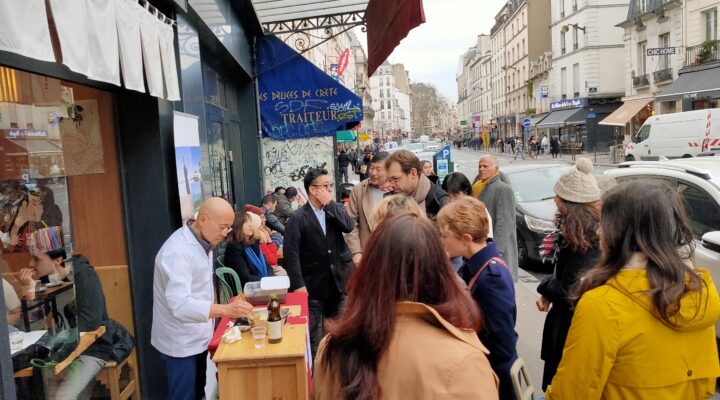
JAPAN Fes Paris has repeatedly featured dorayaki from Usagi Delice.
The festival describes the product as fluffy dorayaki filled with red bean paste and presents Usagi Delice within the context of Japanese street food.
JAPAN Fes Paris: May 17, 2025 — Usagi Delice Dorayaki
The same dorayaki appears in other JAPAN Fes Paris events as well.
Here, the context has changed.
A confection that is strongly associated with wagashi culture in Japan is presented to an international audience as part of a Japanese street-food experience.
7. Japan, New York, and Paris: Three Different Contexts
These examples suggest three different ways of understanding dorayaki.
In Japan, dorayaki is primarily understood as an approachable wagashi and everyday confection.
In New York, it has appeared at JAPAN Fes, but there is not yet a standardized festival format.
In Paris, dorayaki is being actively presented within a Japanese street-food context.
There is therefore no single definition of festival dorayaki.
And that is exactly what makes the subject interesting for a professional pastry chef.
Part IV —So What Should a Dorayaki Festival Dessert Look Like in New York?
8. New York Doesn’t Have a Fixed Dorayaki Festival Format Yet
If you are a pastry chef in New York, you do not necessarily have to reproduce a Japanese dorayaki exactly as it is sold in Japan.
You can ask a different question:
What should a dorayaki festival dessert look like in New York?
A festival creates different requirements from a restaurant dessert.
The portion needs to be easy to handle.
The filling needs to work in the expected temperature and service conditions.
The product needs to be visually recognizable.
The preparation needs to work at festival speed.
And the flavor needs to make sense to the audience you are serving.
These are product-design questions, not simply recipe questions.
9. Don’t Just Copy a Japanese Dorayaki. Design a Dorayaki for Your Festival.
This is where a professional pastry chef has room to create.
You might keep the traditional dorayaki shell but change the filling.
You might combine anko with cream, custard, fruit, chocolate, or another ingredient that fits your concept.
You might serve it chilled.
You might create a smaller format for easy eating.
You might pair it with ice cream, as the 2019 JAPAN Fes example did.
The important question is not:
“How can I make a modern dorayaki?”
It is:
“What kind of experience do I want my dorayaki to create at this festival?”
Start with the festival.
Then design the dorayaki.
Part V — But Before You Reinvent Dorayaki, Understand the Original
10. Know the Original Before You Reinterpret It
Creative freedom does not mean that the original structure is unimportant.
Quite the opposite.
The more creatively you want to reinterpret dorayaki, the more important it becomes to understand the original structure first.
A professional pastry chef needs to understand what makes the shell work before changing it.
That includes the batter formulation, viscosity, heat control, browning, thickness, softness, moisture, and the relationship between the shell and the filling.
Dorayaki is not simply an American-style pancake with anko added between two pieces.
The shell has its own formulation and baking behavior.
The balance between the shell and filling is also part of the identity of the confection.
11. The Shell Comes First
Imagine developing a new festival filling.
It may be delicious on its own.
But if the dorayaki shell is too dry, too thick, too sweet, too firm, or unable to hold the filling properly, the final product will not work.
The shell has to support the filling.
Its texture, moisture, sweetness, and thickness all affect the eating experience.
This is why understanding the original technique matters even when your final product will be highly contemporary.
A festival filling cannot rescue a poorly engineered dorayaki shell.
Related Articles : Q. What Defines Dorayaki? The Art of Harmony Between Anko and Cake
Part VI — Now Design Your Own Festival Dorayaki
12. Start With the Festival, Not the Recipe
Before developing your filling, define the experience.
Do you want a refined Japanese tea-inspired dessert?
A playful New York street dessert?
A seasonal Japanese creation?
Or a signature dessert that reflects your restaurant’s own culinary identity?
The answer can influence everything from the filling to the size, temperature, texture, and service method.
The possibilities are much broader than simply choosing between anko and custard.
13. Traditional Structure, Contemporary Experience
A dorayaki can remain recognizably dorayaki while the overall experience becomes contemporary.
You can preserve the essential shell structure while changing the filling.
You can combine traditional anko with a modern ingredient.
You can use traditional techniques while changing the serving temperature.
You can create a festival format without abandoning the character of the original confection.
This is not about making dorayaki “more Western.”
It is about understanding the original well enough to make deliberate decisions about what to preserve and what to change.
14. The Opportunity for New York Pastry Chefs
Dorayaki has already entered Japanese food festivals in New York.
Paris has shown that it can also function naturally within a Japanese street-food environment.
But New York has not yet developed one dominant festival format for dorayaki.
That leaves room for experimentation.
A pastry chef does not have to ask only:
“How do they make dorayaki in Japan?”
A more interesting question may be:
“What can I create with dorayaki once I understand how it is supposed to work?”
That is where tradition becomes a foundation for creativity.
Conclusion- Don’t Just Copy a Japanese Dorayaki. Design a Dorayaki for Your Festival.
The more creative your idea becomes, the more important the fundamentals become.
Understand the batter.
Understand the baking process.
Understand thickness and texture.
Understand the relationship between shell and filling.
Then decide what your festival needs.
Know the original before you reinterpret it.
And once you understand the original, you have much more freedom to create something that belongs to your own culinary world.
That may be the next chapter for dorayaki in New York.
Not simply reproducing a Japanese sweet.
But designing a new dorayaki experience for the people, place, and festival in front of you.
If you want to create your own dorayaki rather than simply reproduce one, start with the foundation in Our Bundle Dorayaki Online School.
In Our Bundle Course. First, using your existing kitchen equipment and a standard crepe pan, you’ll thoroughly master the fundamental principles of moisture retention in dorayaki, the balanced three-ingredient ratio, and the technique for achieving a beautiful, even texture through online instruction. This will allow you to develop a base recipe of authentic quality that’s ready to be sold at the festival.
See our online course.