Q. What is the secret to a uniform golden brown color on Dorayaki?
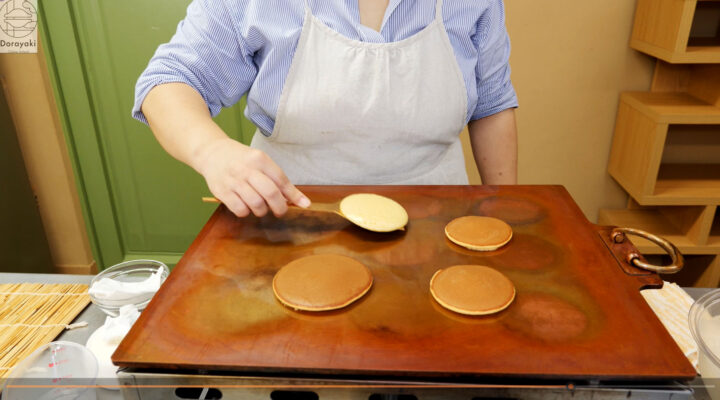
In professional pastry, surface quality is the first and most unforgiving point of judgment, and a premium Dorayaki lives or dies by the visual integrity of its skin. Unlike the rustic, irregular char of a Western griddle cake, an artisan Dorayaki demands a geometrically precise round and a matte, velvet-textured golden-brown finish — entirely free of oil spotting, heat staining, or tonal variation. The formulation itself is engineered to support this standard: for a yield of 26 pieces at 8cm diameter, a batter built on 420g whole eggs, 400g Johakuto sugar, 30g honey, 6g baking soda, 500g pastry flour, and approximately 250g water is already calibrated to drive a controlled, even Maillard reaction. And when the interplay of honey, sugar, and optional Mirin is handled with technical precision, this deceptively simple mixture becomes a high-margin product fully capable of commanding premium placement on any serious New York menu.
But sustaining that visual standard across a high-volume batch during dinner service is an entirely different discipline. Fluctuating ambient humidity, continuous thermal buildup on the griddle, and batter that shifts in viscosity as service progresses work constantly against consistency — and a single lapse in any one variable is enough to compromise an entire run. However, by enforcing a rigorous checkpoint protocol across six specific technical parameters, operational variance can be eliminated and visual reproducibility locked in at production scale.
Thermodynamic Standardization: A traditional heavy copper flat-top offers superior heat retention, but a standard commercial griddle will perform equivalently — and yet only if you actively manage heat migration in real time. Excessive surface temperature produces aggressive dark centers with pale rims; insufficient heat leaves the skin dry and under-colored. Therefore, you must continuously adjust flame intensity to compensate for the thermal accumulation that builds across hours of uninterrupted service.
Micro-Oil Film Management: A neutral, high-smoke-point oil is essential to condition the cooking surface, but any visible residue remaining after application will produce irregular spotting and marbling that cannot be corrected post-cook. Therefore, the oil must be applied and immediately wiped off entirely with a clean towel — the surface must appear bone-dry before every pour. This single step is non-negotiable for achieving the signature matte texture.
Batter Viscosity and the Overnight Rest: A freshly mixed batter retains entrained air bubbles, unhydrated flour particles, and residual gluten tension — all of which introduce instability into spread behavior and surface texture. But an overnight rest resolves each of these variables: bubbles dissipate, flour fully hydrates, and gluten relaxes into a stable, predictable viscosity. Therefore, baking soda must also be pre-dissolved in water before incorporation into the rested batter; dry addition creates localized chemical reactions that leave dark spots directly on the finished skin.
The High-Drop Pour: Gravity is your most reliable forming tool, and a ladle raised to a fixed height above a single target point will produce a geometrically consistent circle with no further intervention. But any contact with a spatula after the batter hits the surface immediately disrupts surface tension and introduces structural blemishes — therefore, once the pour begins, the batter must not be touched until the flip.
Reading the Flip Cue: Timing the flip is precise and unforgiving. Fine micro-bubbles emerging along the outer edge, combined with a rim that has just begun to set, signal the exact window — but that window is narrow, and hesitation past the point where the central surface begins to break or dry will cost you the finish. Therefore, the flip must be executed in a single, confident motion the moment those cues align.
Continuous Station Maintenance: Extended baking continuously deposits invisible layers of caramelized sugar, residual oil, and particulate residue onto the griddle surface. But these accumulations are not visible between pours — they transfer silently onto the next batch, producing staining, bitter off-flavors, and progressive batch-to-batch inconsistency. Therefore, griddle scraping and wiping must be treated as an active, continuous station task throughout service — not an end-of-shift cleanup.
Mastering these variables individually is achievable, and building them into a repeatable team protocol is what separates a strong pastry program from an inconsistent one. Therefore, to systematically eliminate operational variance and develop your team’s capacity to deliver production-level visual consistency, you need a structured framework that goes beyond a written recipe.
The Dorayaki Professional Mastery Path Bundle provides exactly that — a comprehensive digital curriculum covering batter rheology, pouring mechanics, and oil management protocols in precise visual detail, designed to let your team build and refine griddle skills within your current kitchen setup, at production pace. But foundational knowledge alone does not build the calibrated sensory judgment that high-volume service demands. Therefore, the definitive next step is the 3-Day Intensive Live Schooling in Tokyo — a hands-on residency under master Wagashi chefs where you will develop the real-time heat management decisions, fine hand adjustments, and sustained consistency techniques that only direct, supervised practice at the source can establish.
Learn the craft where it originated. Set the standard in your kitchen.
[Explore The Dorayaki Professional Mastery Path Bundle & Tokyo Live Schooling →]